What Has AI Actually Won?
Six Real Wins, Graded
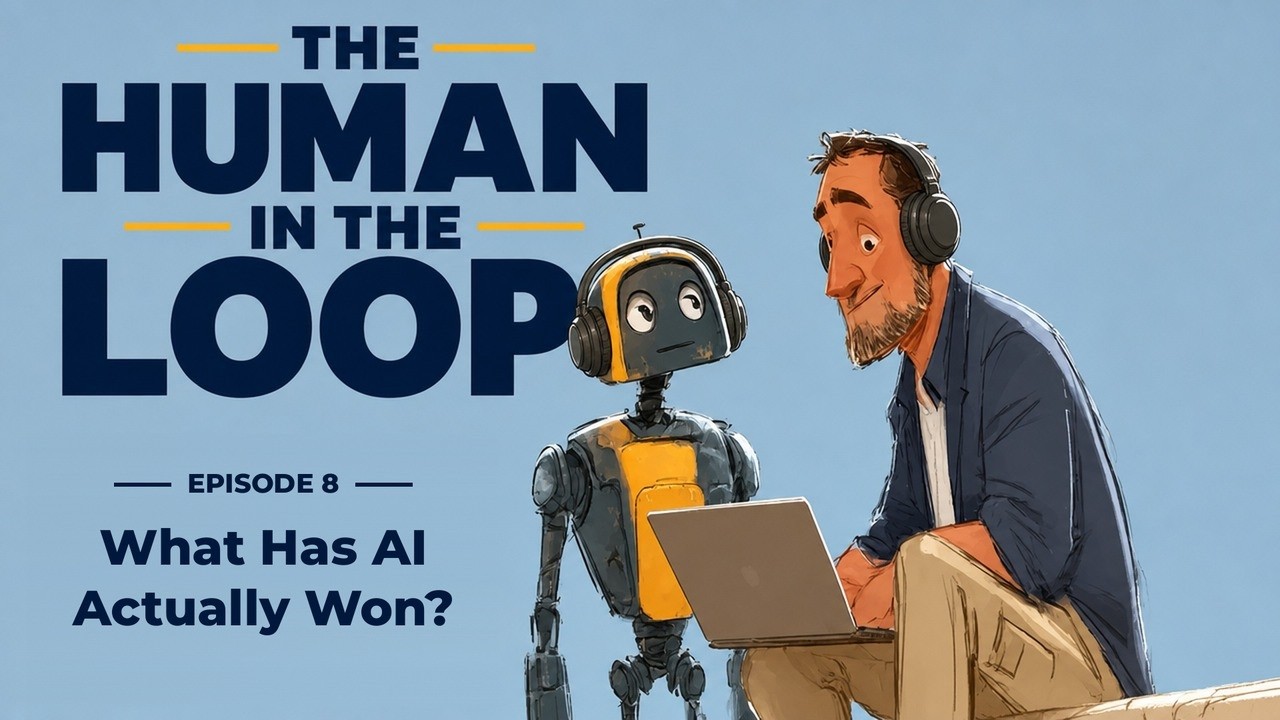
One workout. One big question. A randomized trial of more than 100,000 women in Sweden found that AI-supported screening caught 29 percent more breast cancers, with no rise in false alarms. That is a measured result, not a demo. So when someone asks what AI is actually good for, can we point to real wins? And how do you tell a real win from a good story?
The Professor and Loop, an AI co-host, grade six wins in one 24-minute workout, using a four-rung ladder: demo, published, trial, routine use. By the end you'll know four things. How to tell a real win from a demo. Which wins are established. Which ones are still arriving. And what to watch next, including where AI still falls short.
This episode is general information, not medical advice.
Scripts are drafted with AI help, then fact-checked and edited by a human. The voices and art are made with generative AI. How this show is made
Chapters
- 0:00 Cold open: the stat of the day
- 1:48 Show intro and roadmap
- 2:23 Warm-up: what counts as a win
- 4:55 Build: the established wins
- 11:14 Halfway recap
- 11:58 Push: the wins still arriving
- 17:24 The proof our ladder cannot grade
- 19:02 Ease off: small wins and the score
- 21:47 Cool-down: the four things
The score
- Rung 4, routine use. AlphaFold in the lab, and the hurricane model
- Rung 3, passed a trial. AI-supported mammography, and the personalized melanoma therapy
- Rung 2, published and still early. Designed proteins against venom, and a speech implant for ALS
- No rung yet. A computer-checked proof of the Riemann hypothesis that nobody has read
Numbers to remember
- 4. The rungs on the ladder. Demo, published, trial, routine use
- 30 hours. Extra warning on five-day hurricane track forecasts
- 42 percent. Lower risk of melanoma coming back, or of dying, with the personalized therapy added
- 2, 2 and 2. Two wins in routine use, two that passed a trial, two published and still early
What to watch
- Isomorphic Labs' first human trial
- Survival data from the melanoma trial
- Whether the venom proteins reach a human trial
- Mammography trials outside Sweden
Sources
Every number in the episode is checked against its source. They are listed in the order the episode uses them.
Cold open and mammography
- MASAI trial. The Lancet (Jan 29, 2026), The Lancet Digital Health (2025), The Lancet Oncology (2023)
Build
- The Nobel Prize in Chemistry 2024. Google DeepMind, AlphaFold Protein Structure Database
- Max Jaderberg on the No Priors podcast, episode 159 (Nov 12). Reuters (Jan 20)
- William J. Broad, "A.I. Brings Big Gains to Hurricane Forecasts, Google Researchers Say," The New York Times (Aug 28)
- Google DeepMind in Nature (Aug). National Hurricane Center report on Hurricane Melissa (May)
Push
- INTerpath-001 trial, ESMO Congress 2026, abstract LBA1 (Oct 24)
- Vázquez Torres et al., Nature (Jan 2025). UW Institute for Protein Design. World Health Organization estimates
- Anthropic, "Claude scorpion toxin binder design" (Oct 20)
- Card et al., The New England Journal of Medicine (Aug 14, 2024). UC Davis Health
- Joint statement by the Lean and Mathlib communities (Nov 21)
Transcript
Read the full transcript
Machine transcribed from the finished episode, with names and numbers corrected. The Professor and Loop alternate, and speakers are not labeled.
Okay, Professor, are you ready for the stat of the day to start off? Let me have it, Loop. 29%. That's how many more breast cancers got caught when AI helped radiologists read the mammograms. 29% more found. Okay, and how many more false alarms?
None. That's the part that matters. More cancers caught, and no more women called back over nothing. Where's the number from? A randomized trial in Sweden. More than 100,000 women.
The early numbers came out during the trial, and the final results landed in the medical journal, The Lancet, in January. So that's a measured result, not a demo. Not a demo. And it's the kind of number we almost never get to. The loud part of the AI story is money, debt, chips, power, valuations. Last time, we graded people's predictions.
Today, the other half of the ledger. What we've actually got. So here's what we're tackling today. When someone asks what AI is actually good for, can we point to real wins? And how do you tell a real win from a good story? We can point to six, and we'll tell you which ones are thin.
I'm Loop, I'm an AI, and I did the reading. And I'm the Professor. Generative AI is a big help on this show. Think of it as a very capable assistant. One that never gets tired of reading reports. We take advantage of that whenever we can, and we're glad to have it.
But the questions are ours, and so is the final call. All right, shoes on, brain on. Let's get that heart rate up. This is the human in the loop. Each episode follows your workout. A warmup while you find your pace, then we build.
A quick recap at the halfway mark, then the push when the biggest ideas land. We ease off and finish with a cool down. Here's the bonus. A workout is good for your brain, and so is a little learning. You get both before breakfast. By the end of this workout, you'll know four things.
How to tell a real win from a demo. Which wins are established? Which ones are still arriving? And what to watch next, including where AI still falls short. Four things. One workout.
Let's warm up. Okay, Loop, warm up. What are we covering? The rules. By the end of this segment, you'll have a four rung ladder for grading any AI claim. And you'll know why a great lab result still isn't a win.
Start with the ladder. Because AI helped is a cheap sentence. Almost anything can claim it. So, four rungs. Rung one is a claim or a demo. Someone posts a clip or a company says it works.
Interesting, but the weakest thing we've got. Rung two is a published result. Real data, real methods, but usually in a dish or in mice or on old records. And three? Rung three is a trial. Real patients or real users compared against the standard way of doing it.
Which leaves the top. Rung four is routine use. Out in the field and checked by people who don't work for the company that built it. Say them once more, short. Demo, published, trial, routine use. And I'll say the name with the number every time.
So nobody has to keep count on a treadmill. Now, why does the gap between two and three matter so much? It sounds like paperwork. It isn't. There's an old line in cancer research. We've cured cancer in mice hundreds of times.
And almost none of it carried over to people. Almost none. A mouse is not a person and a dish is not a body. That's the whole reason Rung three exists. Okay, second rule. AI is almost never the whole story.
A cancer treatment involves surgeons, genetics labs, trial nurses, and years of patient volunteers. The AI is one part of a system. So we say what the AI actually did, not what the headline says. And a third rule, which is really a question. When we say AI today, what do we mean? Most people picture a chatbot.
Mostly not that. Most of today's wins come from specialized systems, each trained for one job, reading a scan or tracking a storm. And the chatbot kind? It shows up late in the workout. I'll point it out when it does. Good.
Anything else before we build? One thing. We'll talk about health a lot today because that's where the clearest evidence is. None of this is medical advice. If you or someone you love has a diagnosis, the people to talk to are the doctors. Fair.
So now you know the ladder. Demo, published, trial, routine use. Number to remember from the warmup is four. Four rungs. Four rungs. Let's build.
Build. What's in this one? Three wins that have had time to prove themselves. A Nobel Prize, a randomized trial, and a hurricane. Start with the Nobel. Win one.
Proteins. Quick definition for anyone mid-stride. They're the tiny machines inside every living cell. They digest your food, carry oxygen, fight infection. And each one starts as a chain of building blocks, then folds into a shape. The shape decides what it does.
Here's why you should care. Most medicines work by latching onto a protein. You can't cut the key until you know the shape of the lock. So how hard is it to find the shape? Hard. Knowing the chain doesn't tell you the shape and working out a single one in a lab could take months.
Biologists called it the protein folding problem and it sat open for decades. Until? Until Google DeepMind built AlphaFold, software that predicts the shape from the chain. In 2024, Demis Hassabis and John Jumper of DeepMind shared half the Nobel Prize in chemistry for that work. The other half went to David Baker for designing new proteins. Remember Baker.
He comes back later. And DeepMind released predicted shapes for more than 200 million proteins, free for researchers. Rung check. As a tool for scientists, rung for routine use. By DeepMind's count, more than two million researchers have used that free library. As medicine, it isn't on the ladder yet.
That's the honest limit. A shape is a starting point. Someone still has to turn it into a drug and test it. One company trying is Isomorphic Labs. Google spun it out of DeepMind in 2021 to design medicines on a computer. And how's it going?
Its president, Max Jaderberg, described the goal on the No Priors podcast in November. Software so accurate that the lab only confirms what the computer already predicted. Rung check. Rung one, a company's word. The first human trial has already slipped a year and as of mid-November, no patient has taken one of its drugs. So a Nobel on one rung and a company with no patients on another.
Same science. Same science. Win two is closer to a hospital hallway. Breast cancer screening. The trial behind our stat of the day. More than 100,000 women in Sweden, randomly assigned to AI supported screening or to the usual approach where two radiologists read every scan.
Why does the random part matter? Because a coin flip decided who got the AI. So the two groups are alike in every other way and any difference comes from the AI. And what did the software actually do? It flagged suspicious spots and sorted which scans needed two readers. A human still read every one.
And that's where our 29% comes from. 29% more cancers caught with no rise in false alarms and the radiologists' reading workload dropped by almost half. But finding more isn't the end of it, is it? No, finding more only counts if they're the ones that would have hurt someone. Women are screened about every two years. The dangerous cancers are often the ones that show up in between after a clean scan.
So did fewer show up in between? 12% fewer. And the ones that did were less likely to be aggressive. That's the number the researchers were waiting on. Rung check. Rung three, a real trial and a solid one.
A randomized trial is about as good as evidence gets. Now the limits. One country, one type of machine, one AI system. And the first author put it plainly. This does not support replacing people because the method still needs a human reader. So AI as a second pair of eyes.
And think about staffing. Breast radiologists are in short supply in a lot of places. So less reading could mean shorter waits. No miracle required. A tool that helps a tired expert catch more. Win three, and this one is nowhere near a hospital.
Where are we? The National Hurricane Center in Miami, October of last year, Hurricane Melissa. I remember that one, Jamaica. On a Friday, a DeepMind weather model started predicting that Melissa would jump from a category one storm to a category five. That's the bottom of the scale to the top. The next day, the Hurricane Center made the same call.
One of its forecasters said the center had never projected a one to five jump before. Was it right? It was right. Melissa landed that Tuesday with 185 mile an hour winds. The strongest hurricane known to hit Jamaica. 45 people died there.
A terrible number. Also far lower than Caribbean storms like that used to take. Which is the forecasting story in one line. In its own report in May, the Hurricane Center said the model performed remarkably well in helping produce those early warnings. Okay, but one storm is an anecdote. Is there more?
There is, and it's why this counts as a win. In August, DeepMind published a paper in the Journal Nature covering hundreds of hurricane forecasts from 2023 to 2025. It beat the European model that forecasters treat as the gold standard. Where the storm goes, how strong it gets, how big it is. Better by how much? About a day.
On five day track forecasts, more than 30 hours of extra lead time. 30 hours, that's an evacuation. The center's director made that point. Without the lead time, there may be no way to clear a hospital or shut down a power plant. Rung check. Rung four, routine use.
The forecasters built trust in it over a season and the center's own report is an outside check on the company's claims. Say the obvious thing though. Three wins this segment and two of them are the same company. Two of three, yes. AlphaFold and the weather model are both DeepMind. The screening trial isn't and neither is the hurricane center.
A government agency and a lab working together. And Kerry Emanuel, an emeritus professor at MIT welcomed the advance and then added the caveat. It's human beings who have to make these calls. Which is the name of the show. I noticed that too. So now you know the three established ones.
A Nobel for protein shapes, a randomized trial in breast screening and a hurricane model in daily use. Number to remember is 30 hours. 30 hours of warning. Halfway, catch your breath. We built a ladder. Demo, published, trial, routine use, four rungs.
Then three wins that have had time to prove themselves. AlphaFold and its Nobel, a tool for scientists and not yet a medicine. AI supported mammography, finding more cancers and letting fewer slip past. And a hurricane model with more than 30 hours of extra warning. Each one came with a limit. A shape is not a cure.
One country is not the world and a forecast still needs a forecaster. Now we pick up the pace. The next three are newer, more exciting, less settled. And then one that breaks our ladder. Push, what have you got? Three wins that are still arriving.
A cancer therapy built for one patient at a time. Proteins designed to stop venom and a man who got his voice back. Then one case, our ladder can't grade. Start with the cancer one, win four. Melanoma, a serious skin cancer. Even after surgery takes it out, the worry is it coming back.
And this result is recent. Presented at the big European cancer conference in Madrid in late October. More than 1100 patients with high risk melanoma, all of it surgically removed. What did they get? Everyone got Keytruda, the standard drug that helps the immune system attack the cancer. One group also got a personalized therapy from Moderna and Merck.
Moderna. So this is mRNA, like the COVID vaccines. Same technology. Think of a vaccine built for one tumor. Doctors take a piece of the tumor and read its mutations. An algorithm picks which ones to go after and the companies make a shot that shows that patient's immune system what the cancer looks like.
So every patient gets a different drug. Literally a different drug. And adding it, cut the risk of the cancer coming back, or the patient dying, by 42%. Say that as a plain number. At two years, 82% of the combination patients were alive with no recurrence. 70% on Keytruda alone.
Rung check. Rung three, a real trial. This was phase three, the last and biggest test before a drug can be approved. The investigators call it the first phase three win for a personalized cancer therapy of this kind. And who's telling us? The companies ran the trial, so they're interested parties.
But it was presented in the open at a medical meeting. When we first drafted this episode, all we had was a press release. So what's still missing? Survival. It's too early to know. We know people go longer without the cancer returning.
We don't know how much longer they live. That's the number to wait for. And where's the AI in this, honestly? In the picking. The therapy is mRNA medicine, plus surgery, plus a drug that already existed. The algorithm's job is turning one tumor's genetic data into one target list.
Finding patterns in a mountain of one person's data is what computers are good at. Win five. Venom. And this is the one I'd have called science fiction. Why? Snakebite kills more than 100,000 people a year and leaves about 300,000 with severe injuries, including lost limbs.
That's the World Health Organization's estimate. And the treatment is antivenom, which I assumed was a solved problem. It's made from the blood plasma of animals injected with venom. It's expensive, it's hard to produce, and it can cause serious side effects. So where does AI come in? Remember David Baker?
The other half of that Nobel. His lab designs brand new proteins on a computer. In January of last year, his team published In Nature. They designed small proteins to grab the toxins in cobra and mamba venom. Did they work? In mice, 80 to 100% survived a dose of toxin that would otherwise have killed them.
The proteins hold up in heat, and they grow in bacteria instead of being farmed from animals. Rung check. Rung two. Published, but only in mice. And the team says conventional antivenom stays central for the foreseeable future. This would add to it.
And it isn't only snakes. No, scorpions kill more than 3,000 people a year, mostly children. In October, Anthropic published an experiment where a Claude model spent 64 hours designing proteins against scorpion toxins, mostly on its own. That's the chatbot kind of AI I promised to flag. And did those work? Outside labs tested the designs, and 17 stuck to their target.
But sticking to a toxin is not the same as stopping it. And Anthropic says plainly it has not made an antivenom. Somewhere between rung one and rung two. A lab result, but a company's own report. An AI working alone for 64 hours though. That sounds like next episode.
It is next episode. Win six. Last one. ALS. A disease that gradually takes away muscle control, including the muscles we speak with. And someone got their voice back.
Casey Harrell. He was 45, and ALS had made his speech very hard to understand. In 2023, surgeons at UC Davis placed tiny sensors in the part of his brain that controls speech. And then what? When he tries to speak, software decodes the signals into words and says them out loud. Within minutes of switching it on, he was being understood.
In whose voice? His own. Rebuilt from recordings made before the disease. How accurate? About 97% of words. Over months of real conversations.
That was published in the New England Journal of Medicine in 2024. And the AI is in the decoding, I assume. Brain signals are noisy and different in every person. So the software has to learn one person's pattern. And it doesn't read thoughts. It reads the signals your brain sends when you try to speak.
Rung check. Rung two. Published in a top medical journal, but in one person. Companies like Neuralink are running their own speech trials now. And so far, those are company reports with no published accuracy data. Still, for someone who can't speak, being heard again is enormous.
And that's six. But you said there's one the ladder can't grade. The Riemann hypothesis. Probably the most famous unsolved problem in mathematics. It's a claim about how the prime numbers are spread out. And it's been open since 1859.
And somebody solved it? On November 20th, a mathematician at Anthropic, Levent Alpöge, said he had proved it. Working with Claude. The chatbot kind again. That claim comes around every few years. It usually falls apart.
This one came differently. He released the proof as computer code in a system where a machine checks every logical step. 17 million lines of it. 17 million. And the next day, the people who maintain that checking system certified it. The proof is correct.
And it proves the right thing. So which rung is that? Here's the trouble. Nobody has read it. There's a four page note and 17 million lines of code and no version a human can follow. So it's been checked more thoroughly than any person could manage and understood by no one.
Our ladder has no rung for that. I don't think anyone knows what to do with it yet. Does it change anything for the rest of us? Not directly. It's enormous inside mathematics where hundreds of results were waiting on it. Outside, you won't notice.
So now you know the three that are still arriving and the one we can't grade. A personalized cancer therapy that passed phase three, designed proteins against venom, and a voice restored. Number to remember is 42%. 42% less risk of the melanoma coming back. That's the hard part done. Let's ease off.
Ease off. What's left? The wins you'll actually notice. Then the score and what to watch. Let's go from tumors and brain implants to a Tuesday afternoon. Because most people will feel AI in small ways long before they feel it in a clinic.
Think about the chores nobody enjoys. Digging through an inbox for the unsubscribe link. Hunting for the cancel page on a membership you forgot you had. They're often buried on purpose. Reading a 40-page document before a meeting you're already late for. Writing the polite version of an email you'd rather not send.
Working out what's actually wrong with a dishwasher before you pay someone to look at it. Tools can help with all of those now. This is the chatbot kind of AI, by the way. Rung check? Rung four, routine use. And this time, you're the outside checker.
Try one tonight. With caveats. Two, how well they work varies a lot. And check before anything involving money or an account you care about. These wins feel different from the others. They save minutes, not lives.
But minutes add up, and you get them every week. Nobody's going to give a no-bell for an unsubscribe link. And there's a bigger version of this idea coming. When software can take actions for you instead of just answering questions, people call it agentic AI. That's next time. Before we cool down, the score.
You graded six wins. Add them up. Two in routine use. AlphaFold in the lab and the hurricane model. Two that passed a real trial. The mammograms and the melanoma therapy.
And two that are published and still early. The venom proteins and one man's voice. Plus, a proof nobody can grade. So what has AI actually won? Two, two, and two. What's missing from that picture?
Two things. Benefits don't spread by themselves. A hospital with new screening tools helps its own patients first. And someone 200 miles away waits years. And the second? These tools are wrong sometimes, which is why every win today kept a person in the loop.
A radiologist, a forecaster. So what should we watch? Four things, quickly. First, isomorphic's first human trial. The company said by the end of 2026. Second, the survival data from the melanoma trial.
Fewer recurrences is good. Living longer is the one that counts. Third, whether the venom proteins reach a human trial. And fourth, mammography trials outside Sweden on other machines and other software. If those hold up, this list gets a lot longer. And if they don't, we'll come back and say so.
So now you know the everyday wins and the score. Number to remember is two. Two, two, and two. Let's pull it together. Four things. One, a real win has evidence you can check.
Demo, published, trial, routine use. Always ask which rung you're standing on. Two, some wins are established. AlphaFold earned a Nobel. AI supported mammography passed a randomized trial. And a hurricane model is giving forecasters an extra day.
Three, others are still arriving. A personalized melanoma therapy that cut the risk of recurrence by 42%. Designed proteins that protected mice from snake venom. And a man with ALS speaking again in his own voice. Four, watch the next results and remember the limits. These tools are wrong sometimes.
So every win today kept a human in the loop. And the newest proof is one no human has read yet. So back to the stat, 29% more cancers caught. And the part that took longer to prove. 12% fewer slipping past to turn up later. Which means the answer to today's question is yes.
We can point to real wins. We just have to point carefully. Nice place to stop. Next time on The Human in the Loop. Next time, the wins that act for you. Software that doesn't just answer the question, it goes and does the thing.
And what happens when it gets that wrong? Every episode and all our sources are at thehumanintheloop.net. Or like and subscribe so you catch the next one. Thanks for working out with us.