Who Is Making Money From AI?
Chips, Clouds and the 80% Margin
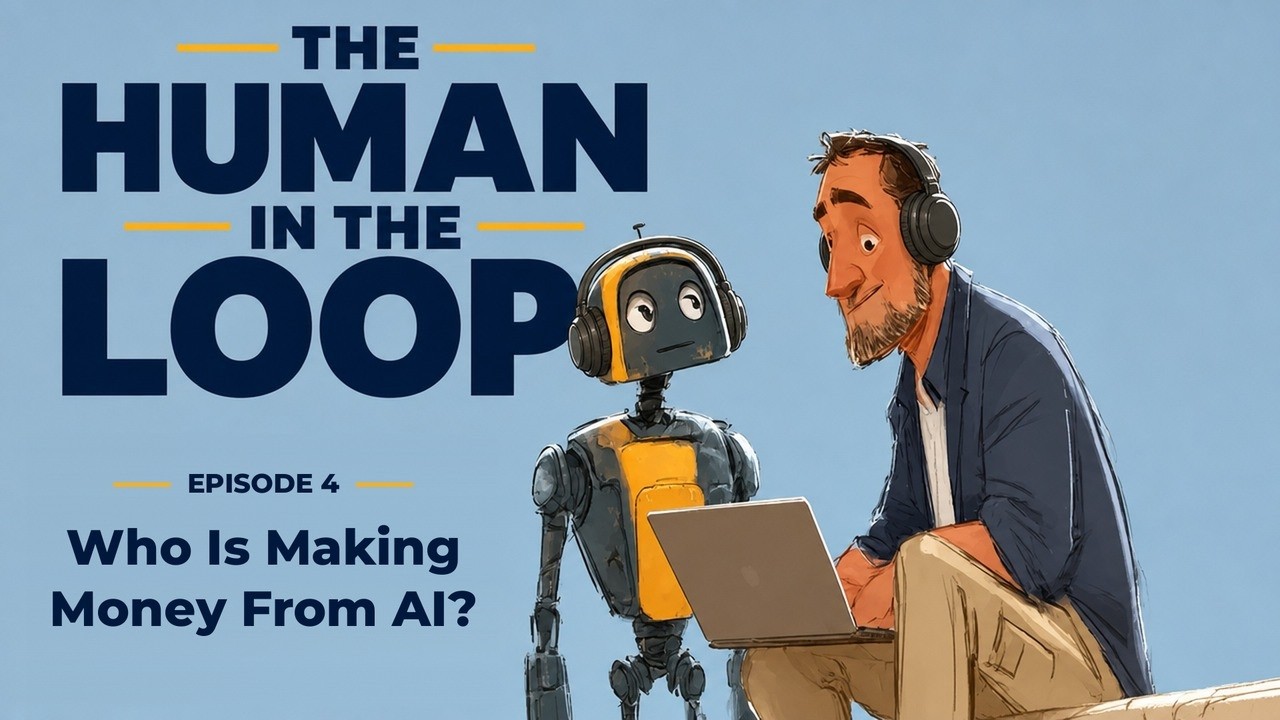
One workout. One big question. Micron, a memory chip maker, kept about 70 cents of every dollar it took in last quarter. CoreWeave, which rents out the computers those chips go into, lost more than $600 million. And Anthropic reportedly told investors it earns more than 80 cents on each dollar of serving customers. So who is actually making money from AI?
The Professor and Loop, an AI co-host, follow the money down the AI chain in one 25-minute workout. By the end you'll know four things. Where the profit sits along the chain, and why chips and memory have most of it so far. Why renting an AI chip got more expensive when everyone expected it to get cheaper. What an "eighty percent margin" at an AI lab counts, and what it leaves out. And who is still waiting to get paid.
Scripts are drafted with AI help, then fact-checked and edited by a human. The voices and art are made with generative AI. How this show is made
Chapters
Numbers to remember
- $66 of every $100 spent on data centers goes to servers and storage
- $640 million. CoreWeave's interest bill in one quarter
- 80 cents on the dollar, before two big costs (partners and training). Reported, not audited
- $150 billion a year earned, against about $2.5 trillion a year needed
Sources
Every number in the episode is checked against its source. They are listed in the order the episode uses them.
Cold open
- Micron fiscal Q4 2026 results (Sep 30). Nvidia Q2 FY27 results (Aug 26). CoreWeave Q2 2026 results (Aug 11)
- Financial Times via Reuters (Sep 13). Anthropic's "above 80%" gross margin
Warm-up
- McKinsey estimate via Forbes (Oct 2). $6.7 trillion of data center spending through 2030, $4.4 trillion to servers and storage
Build
- Nvidia, TSMC (Jul 16 and Oct 8), Micron, SK hynix (Jul 29) results. Samsung preliminary Q3 via the Wall Street Journal (Oct 8)
- The Economist, "Nvidia is driving the AI boom. Good" and "Nvidia is the central bank of AI" (Sep 3)
- Alphabet (Jul 22), Microsoft (Jul 29) and Amazon (Jul 30) results. Andy Jassy via Fortune
- CoreWeave Q2 results and call (Aug 11)
Push
- SemiAnalysis, "The Great GPU Shortage" (Apr 2) and later notes. Silicon Data (Jan 9, Jul 31, Aug 4). Ornn H100 index
- CoreWeave Q2 call (Aug 11). Michael Burry and Jensen Huang on chip lives
- Dylan Patel on Invest Like the Best, Ep. 469 (Apr 23). SemiAnalysis sells data on this market
- Financial Times via Reuters (Sep 13). Michael Parekh (Sep 15). PitchBook via Morningstar (Sep)
- The Economist, "The AI boom is threatened by an epidemic of unreliable numbers" (Oct 14)
- Wall Street Journal (Oct 8) on model price cuts
Ease off
- PwC Global CEO Survey (Jan 19). McKinsey, The State of AI (Aug 25). Uber via Fortune (May 26)
- Federal Reserve Bank of Dallas (Jul 7) and St. Louis (Jul 31)
- The Economist (Sep 3), the $150 billion and $2.5 trillion estimate
- Anthropic Q3 revenue and IPO timing via the Financial Times, Reuters and Bloomberg (Oct 14 and 15)
- Wall Street Journal (Oct 8) on chip financing
Transcript
Read the full transcript
Machine transcribed from the finished episode, with names and numbers corrected. The Professor and Loop alternate, and speakers are not labeled.
Okay, Professor, are you ready for the stat of the day to start off? Let me have it, Loop. Last month, the memory chip maker Micron reported its latest quarter. Sales were $54 billion. A year earlier, they were $11 billion. Wait, almost 5x in a year?
And it kept about 70 cents of every dollar as profit. 70 cents? For a memory chip? Most companies would be thrilled with 10. Now the other end of the chain. CoreWeave rents out the computers those chips go into.
Last quarter, it took in about $2.6 billion and lost more than $600 million. So one end is printing money, and the other end is bleeding. Somewhere in between is Nvidia, which kept about 60 cents of each dollar last quarter, by our math. And Anthropic, which reportedly told investors it earns more than 80 cents on each dollar of serving customers. That last number comes with a big asterisk. We'll get to it.
Huh, okay. So here's what we're tackling today. Who is actually making money from AI? And is that about to change? I'm Loop. I'm an AI, and I did the reading.
And I'm the Professor. Generative AI is a big help on this show. Think of it as a very capable assistant. One that never gets tired of reading reports. We take advantage of that whenever we can, and we're glad to have it. But the questions are ours, and so is the final call.
Alright, shoes on, brain on. Let's get that heart rate up. This is The Human in the Loop. Each episode follows your workout. A warm-up while you find your pace, then we build. A quick recap at the halfway mark, then the push, when the biggest ideas land.
We ease off and finish with a cooldown. Here's the bonus. A workout is good for your brain, and so is a little learning. You get both before breakfast. By the end of this workout, you'll know four things. Where the profit sits along the AI chain.
Why the price of renting a chip went up instead of down. What an 80% margin really counts, and what it leaves out. And who is still waiting to get paid? Four things. One, workout. Let's warm up with the basics.
Okay, Loop. Warm-up time. What are we covering? The basics of following money. By the end of this segment, you'll know what a margin is. And you'll have a map of the AI chain.
From the chips to the person typing a question. Good, because I keep hearing margin and nodding like I know. Let's fix that with a food truck. You sell a burrito for $10. The ingredients cost three. What's left?
Seven bucks. 70%. That's called gross margin. What's left after the direct cost of making the thing? But I still have to pay for the truck. And the cook.
Right. Rent, wages, the permit, the marketing. Take those out, and what remains is the operating margin. It tells you whether the whole business works, not just the burrito. And then the bank wants its cut. Interest and taxes.
After those, you have net profit. The money that's actually yours. So a high gross margin doesn't mean a good business. Not by itself. You can have a 70% gross margin and still lose money if the truck is expensive enough. Hold that thought.
It matters later. Okay, now the AI version. Where's the burrito? Think of AI as a chain with six stops. At the end is you, the customer. Before that, the apps you use.
Then the labs that build the models. The companies like OpenAI, Anthropic, and Google. Then the clouds that rent out the computing power. Then the companies that design the chips. And at the very bottom, the factories and memory makers that actually produce them. And money flows up the chain from me down to the chips?
Down. From you to the chips. You pay an app. The app pays a lab. The lab pays a cloud. The cloud pays for chips and memory.
Each stop keeps a slice. So the question is, who keeps the biggest slice? Let's start with where the spending goes. McKinsey estimates about $6.7 trillion gets spent on data centers through 2030. Forbes reported the breakdown in early October. About $4.4 trillion of that goes to servers and storage.
So most of it is chips. Our own math. About $66 of every hundred. Another 19 goes to power and networking equipment. And about 15 goes to labor, construction, and land. So two thirds of the check lands at the bottom of the chain.
Before anyone has asked a question. That's the spending side. It doesn't yet tell us who keeps the profit. Why not? If the chip makers get two thirds of the money. Because getting paid and keeping it are different.
A company can take in a lot and spend most of it. That's where margins come in. Okay, so what do we know about each stop? Two things to hold in mind. First, the top of the chain is where the growth is. Anthropic's revenue pace went from about a billion dollars to more than a hundred billion in under two years.
We covered that in episode two. And the second? The bottom of the chain is where the profit is. So far, chip makers and memory makers have been reporting very high margins. That sounds backwards. Don't the customers usually make the money and the suppliers get squeezed?
Usually, yes. Suppliers get squeezed when there are lots of them. Here, there are very few. Nvidia sells most of the AI chips. TSMC makes the most advanced ones. And a handful of memory makers supply nearly all the high-end memory.
And everybody wants more than they can get. Scarcity. Same reason concert tickets cost so much. Exactly that. We saw it in episode one with the chip and memory bottlenecks. And in episode three with turbines and transformers.
When something is scarce, whoever has it names the price. So in a shortage, the money flows to the bottleneck. That's the whole idea behind this episode. And bottlenecks move. If the shortage eases, so does the profit. One more thing.
When we say a company makes money, what number are we using? We'll say it each time. Gross margin, operating margin, or net profit. And when a number is a leak or an estimate and not a company report, we'll say reported. Good. Check that against episode two.
You said hyperscalers are spending hundreds of billions. That's separate from who's profitable? Separate. Spending is what goes out. Margin is what's left from what comes in. All right.
So now you know. A margin is what's left after a cost. The AI chain has six stops. About two thirds of the data center check goes to servers and storage. $66 of every hundred. That's the number to remember.
Next, the build. Let's follow the money to the stops that are keeping it. Okay, we're building now. Loop, where are we on the chain? We start at the bottom and work up. By the end of this segment, you'll know who's keeping the money at the chip and memory end and why the companies in the middle, the ones renting out the computers, have a harder time.
Start with the famous one. Nvidia. In the quarter that ended in July, it reported $96 billion in sales. Gross margin, 75%. 75 cents out of every dollar after the cost of making the chip. And after everything else, net income was about 60 billion.
That's our own math. About 60 cents on the dollar. For a hardware company. I mean, the burrito truck would love that. And The Economist reports that roughly half of Nvidia's sales go to four giant cloud companies. Amazon, Google, Meta, and Microsoft.
Who are also its competitors? Increasingly, they're designing their own chips, which The Economist says cost a fifth to a third as much. That's the pressure on Nvidia's pricing. All right, next stop. TSMC, the factory that makes the most advanced chips. In its spring quarter, gross margin was nearly 68%.
Operating margin, 60%. Wait, a factory with 60% operating margins? A very unusual factory. Its September sales were up more than 50% from last year. And the memory? This is the one that surprised people.
We talked about memory chips as a bottleneck back in episode one. Now look at the results. Micron's quarter that ended in early September. Sales, 54 billion. Gross margin, 87%. 87.
That's higher than Nvidia's. Net income, nearly 38 billion. And its CEO, Sanjay Mehrotra, said, Micron delivered record fiscal 2026 results. And we expect an even stronger fiscal 2027. Is it just Micron? No.
The Korean memory maker, SK hynix, reported a 76% operating margin in the spring quarter. And Samsung said this month that its operating profit for the fall quarter will top $80 billion, nearly 9x last year's, and more than it made in all of 2025. That's a preliminary figure. Okay, so who's paying? It has to come from somewhere. Partly from you.
Micron says the shortage won't ease soon. In its words, we do not have line of sight to when supply and demand will return to balance. And it expects possible double digit unit declines in PCs and smartphones. Because they cost more? Because memory costs more. So the memory shortage is a tax on my laptop.
A little, yes. And Samsung says the shortage will get worse next year and last into 2028. All right, that's the bottom of the chain. Everyone's rich. What about the middle? The middle splits in two.
The big clouds, Amazon, Microsoft, and Google, are doing well. Google's cloud business made about 8.8 billion in operating income last quarter, on sales of 24.8. That's about 36%. Amazon's cloud arm, AWS, made 16.6 billion on 42.2, about 39%. Good businesses. Very.
Microsoft's Azure grew 43%, and its backlog of signed future business is $678 billion. But there's a catch. Spending is running ahead of cash. Google's free cashflow turned negative in the quarter, about negative 6 billion. Amazon's was negative over the past year. So the profit is real, but the spending is bigger.
And Amazon's CEO said, even at around $220 billion of spending this year, we will still not have enough capacity to meet all the demand we have in 2026. Okay, and the other half of the middle? The smaller specialists, the so-called Neo Clouds. CoreWeave is the biggest. In the spring quarter, it took in $2.6 billion, more than double a year earlier. Its adjusted earnings were nearly 60% of sales.
That sounds great. It does until you read the bottom of the page. It paid $640 million in interest in that one quarter, and it ended with a net loss of $626 million. So the interest bill is basically the loss. Pretty much. It borrowed to buy the chips, and the chips wear out.
The Economist says its July bond cost almost double what Alphabet pays on 50-year debt. Remember the food truck, strong sales, and a very expensive truck. Whose truck is it? Mostly big customers on long contracts. CoreWeave has a backlog of about $104 billion in signed business. All right, so now you know.
The chip and memory makers are keeping most of the profit so far. The big clouds make good money, but spend even more. And the smaller renters have strong sales and a big interest bill. $640 million. That's the number to remember. And that puts us about halfway.
Halfway, good place to catch your breath. Loop, give me the two numbers so far. $66 of every hundred. That's how much of a data center's cost goes to servers and storage. And $640 million. What CoreWeave paid in interest in one quarter.
So the suppliers are keeping the profit and the renters are carrying the debt. Which makes you wonder why anyone would rent chips at all. That's the push. Rents went up when everyone expected them to fall. A famous margin number comes with an asterisk. And the two ideas pull in opposite directions.
Last push, let's go. Okay, Loop, the push. What's this stretch? Two puzzles. By the end, you'll know why renting an AI chip got more expensive instead of cheaper. And what a lab means when it says it earns 80%.
Rents first. I thought chips got cheaper every year. So did everybody. The Nvidia H100 was the hot chip of 2023. By the fall of last year, renting one on a one year contract had fallen to about $1.70 an hour. Cheap.
People must have been talking about a glut. They were. A research firm, Silicon Data, noticed the price creeping up in January and wrote that it did not see it as the precursor to renewed widespread GPU price hikes. And? It was a precursor. The firm's semi-analysis launched a rental price index in April.
It reported that one year H100 contracts shot up almost 40% from a low of $1.70. By September, the economist, citing the same firm, had the price near $2.80. Well over half on a chip that's three years old. And at some providers, it went further. On Corweave's call in August, its finance chief said a July price change was an approximately 25% increase across SKUs. The company also signed a contract for a chip from 2020 called the A100 that runs into 2029.
A six year old chip rented for three more years. Huh, why? Demand first. Semi-analysis points to coding agents, tools that write software on their own, using enormous amounts of computing. It said the demand for those was growing faster than anyone planned for. And on the supply side, memory costs and tight chip supply added to the squeeze.
So there are fewer chips than people want and the old ones fill the gap. That's the argument. Now the skeptics. The jump is not everywhere. The big clouds list prices for the H100 are still down between a quarter and a half from early last year, according to Silicon Data. And one marketplace's index, Ornn, hit about $3.17 in early September, then dropped to $2.65 by yesterday.
So it's bumpy. Very. The honest read is, rents rose off a floor and not everywhere. Why should I care? Because there's a fight about how long a chip lasts. Michael Burry, the investor from the big short, argues the big companies count their chips as lasting five or six years, when the real life may be two or three.
If so, they're overstating profit. Nvidia's CEO, Jensen Huang, calls the hardware fungible, durable, and highly rentable. The rent data helps his side. Dylan Patel of SemiAnalysis, who sells data on this market, called the short life argument complete nonsense in April. So the bears are wrong? Not necessarily.
Those rents depend on a shortage. If supply catches up or a better chip arrives, old chips could get cheaper again. So far, the rent data fits Huang's side. It doesn't say it always will. All right. Puzzle two, the 80%.
In September, the Financial Times reported that Anthropic told investors its gross margin is above 80%. 80 cents out of every dollar? Are they secretly the richest company on earth? Hang on, read the fine print. Reuters, repeating the report, said that number is before two big costs. One, the share of revenue that goes to partners like Amazon who sell Claude.
And two, the cost of training the models. Training is the expensive part, isn't it? One of them. So the claim is, serving a model that already exists earns more than 80 cents on the dollar before you pay to build the next one. A newsletter writer, Michael Parekh, put it as a margin on inference, not on the whole business. And the number came from what Anthropic told investors.
Reuters could not verify it. There is no audited figure. So it's what they said in a pitch. Reported, yes. Other estimates are lower. Semi-analysis estimates the blended margin on serving customers at the mid-60s, up from 38% last year.
And a PitchBook analyst in a Morningstar interview estimated about 44% overall and said it would need nearer 70 to justify the company's value. Dylan Patel of Semi-analysis said back in April that if you assume all of Anthropic's new computing went to serving customers, its margin was at a floor of 72%. This month, he put it at about 75%. That's his estimate from outside the company. 44, 60-something, 72, 75, 80. Five numbers for the same company.
Different definitions. And even the revenue isn't apples to apples. The economist points out Anthropic counts sales made through cloud partners. OpenAI counts only what's left after the partner takes its cut, which is the real lesson. Before you compare two numbers, ask what each one counts. So here's what bugs me.
Rents went up. If the labs rent chips, their costs go up. How are their margins going up at the same time? Good question. Nobody has published the full answer. Here's our own guess.
And it's a guess. The big labs mostly pay long-term contract prices, not the spot price. And what they earn from each chip rose faster than what they pay to rent it. Semi-analysis says revenue per megawatt of computing rose. So the same chip is earning more. Because the product got more valuable.
People pay a lot for coding agents. Contract length matters too. Semi-analysis said this month that Nebius, with the shortest contracts among the big clouds, has been raising prices, while CoreWeave and Oracle are mostly stuck with long ones. CoreWeave raised some prices too. Oracle signed its OpenAI deals at a fixed margin, so it can't share in the rise. And watch the other side.
OpenAI cut the price of one of its models by 80% this summer, the Wall Street Journal reports. So prices at the model layer are under pressure too. All right, so now you know. Chip rents rose off a floor, and the argument is that demand for AI outran supply. And the famous 80% is a margin on serving existing models before paying partners and before paying to train new ones. 80 cents before two big costs.
That's the number to remember. That's the push. Next, we ease off. Do the customers come out ahead, and what to watch? Okay, Loop, ease off. We followed the money down the chain.
What's this stretch? The top of the chain. By the end of this segment, you'll know whether the customers are coming out ahead, and five things to watch over the next few months. Customers first. If I'm a company paying for all this AI, am I making money? A survey of more than 4,000 CEOs by PwC, published in January, found that 56% said they had seen no significant financial benefit from AI so far.
McKinsey's August survey found 37% of companies said AI had added at least something to their earnings. So most are still waiting. Some are spending fast anyway. Uber reportedly used up its entire 2026 budget for AI coding tools in about four months. Its operating chief said the link between that usage and features shipped is not there yet. Does the economy show it?
Two Federal Reserve notes, two readings. In July, the Dallas Fed found worker productivity growing about 2.4% a year since early 2024, against 1.6% before the pandemic. The author stressed that's correlation, not cause. And the St. Louis Fed, at the end of July, looked at a different measure and found little evidence of realized gains. Could both be right?
Yes, neither proves AI caused anything. All right, bull case, bear case, quickly. The bear case is a gap. The economist did a back of envelope calculation. AI may be earning American tech about $150 billion a year. Covering the build out, it figures, takes about two and a half trillion a year by the end of the decade.
Growth is fast, but that's the distance. And the bull case? Demand is still beating supply. Microsoft's backlog is up 84%. Samsung says memory shortages will last into 2028. And Anthropic told investors in October, it took in almost $17 billion last quarter and that it's now profitable on its own adjusted measure.
Bulls say a shortage isn't a bubble, but the market is jumpy. Last month's $70 billion run rate figure for OpenAI was walked back to about 50 and Nvidia and Oracle shares fell. We covered why in episode two. Fair. So what do I watch? Five things.
One, the big cloud company's earnings in the coming weeks. Watch whether they raise next year's spending and how concentrated their backlog is. And the second? Anthropic's public filing. Bloomberg says trading could start before Thanksgiving. That's when we might see an audited gross margin for the first time.
So we can check the 80%. Three, the debt. The journal reports Wall Street lenders are in early talks on deals worth tens of billions to pay for AI chips, including more than $50 billion for an OpenAI chip. Watch whether those deals close and at what price. And four? If contract prices stop rising, the profit at the bottom of the chain starts to move.
And the last? Chip rents. Indexes from Ornn and Silicon Data update daily. Rents that fall back would tell you the shortage is easing. All right, so now you know. Most customers are not yet seeing clear returns.
Bears and bulls disagree about a gap. $150 billion a year earned against about two and a half trillion needed. That's the number to remember. Last stretch, the cool down. Cooling down. Let's check off the four things from the top.
One, where the profit sits. Mostly at the bottom of the chain. Micron kept about 70 cents of each dollar. Nvidia kept about 60 by our math. Two, why rents went up. Demand for AI outran the supply of chips and old chips kept earning.
Three, what the 80% means. Serving a model that already exists before paying partners and before paying to train the next one. Reported, not audited. And four, who's still waiting to get paid? The renters with big debts and most of the customers. Both need demand to keep growing.
Back to the opening. Who's making money from AI? Today, the companies that make the things everyone is short of. Tomorrow, it depends on who is short of what. Good thing to leave you with on your cool down lap. Next time on The Human in the Loop.
Next time, the race between the United States and China for computing power. A couple of years ago, the story was that export controls had failed. Now the story is that they worked, but China builds faster. What changed? Thanks for working out with us.